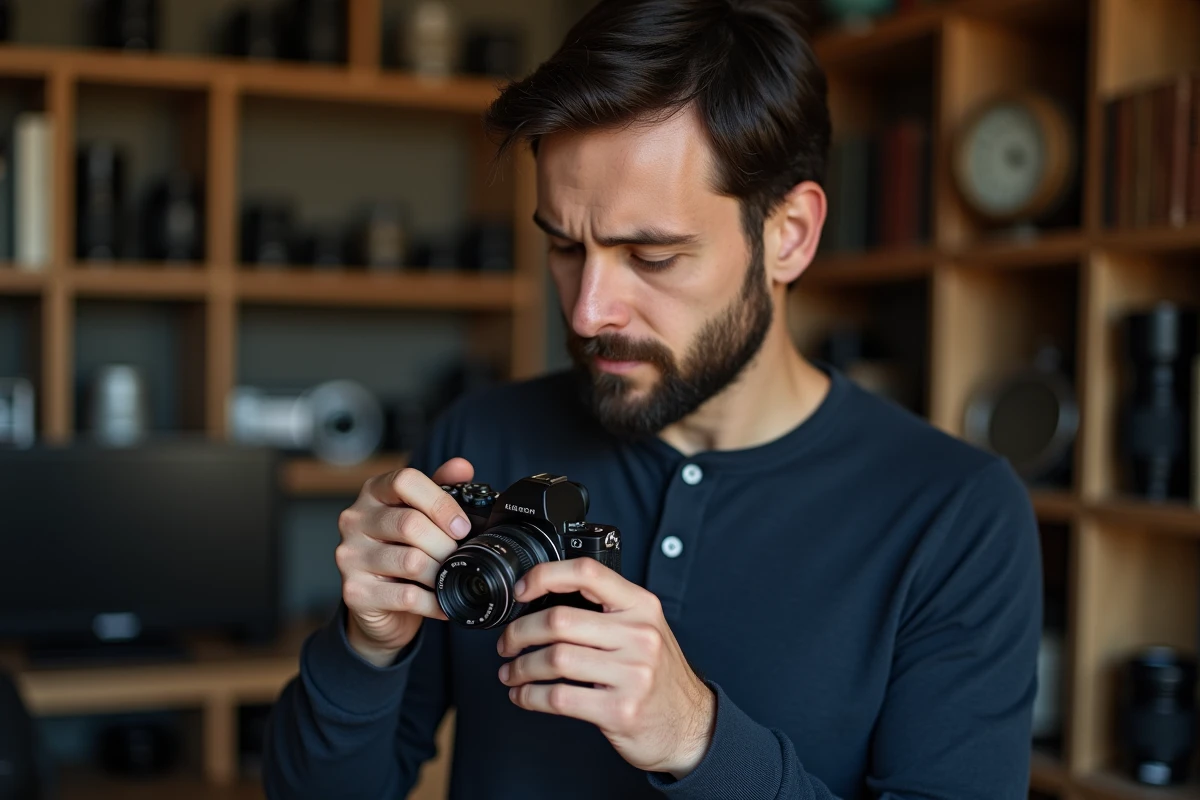
On a camera body, three acronyms keep coming up: AF, MF, and AEL. The first manages autofocus, the second manual focus, and the third exposure lock. These three functions act on distinct parameters, and confusing them can lead to blurry or poorly exposed images.
AEL: Locking Exposure Before Reframing
Most photography guides extensively detail autofocus but quickly skim over AEL. Yet, it is the function that most changes the management of high-contrast scenes. AEL locks the light measurement independently of the shutter release, allowing you to measure exposure on a specific area and then reframe without the camera recalculating the values.
Concrete case: a backlit portrait. Without AEL, the camera’s sensor measures the light across the entire scene and underexposes the face. By activating AEL on the face, the exposure remains fixed even after reframing.
On Sony Alpha hybrids, the AEL button is often reconfigurable. Recent manuals show that it also serves to separate light measurement from shutter release, a use that goes beyond simple spot locking. Canon and Nikon offer similar options through exposure button customization.
To understand the difference between AF, MF, and AEL, it is important to remember that AF and MF affect sharpness, while AEL exclusively affects the light recorded by the sensor.

Autofocus: AF-S and AF-C Modes on DSLRs and Hybrids
Autofocus relies on two main detection families: phase detection and contrast detection. DSLRs primarily use phase detection via a semi-transparent mirror. Recent hybrids combine both methods directly on the sensor, expanding the coverage of the focus area.
AF-S for Static Subjects
The AF-S (Single) mode focuses only once when the shutter is pressed halfway. Once the focus is acquired, it does not move. This mode is suitable for posed portraits, architecture, and landscape photography, where the subject remains still between focusing and shooting.
AF-C for Moving Subjects
AF-C (Continuous) recalculates focus as long as the shutter is held down halfway. The camera tracks the subject and adjusts sharpness in real time. This is the mode to prefer for sports, animal, or moving child photography.
Recent cameras add a layer of subject detection using artificial intelligence (human eyes, animals, vehicles). This detection does not replace the choice of AF mode; it overlays it. Selecting AF-C with eye detection on a Sony or Canon hybrid provides very reliable tracking, but the photographer must always choose between AF-S and AF-C beforehand.
Focus Area: A Complementary Setting
The AF mode (AF-S or AF-C) defines the temporal behavior of focusing. The AF area defines the space in which the camera searches for the subject. These two settings are independent:
- Single point: the camera focuses on a single manually selected focus point, ideal for precise composition
- Dynamic area: the camera uses neighboring focus points if the subject leaves the main focus point, suitable for predictable moving subjects
- Automatic area or tracking: the camera analyzes the entire sensor and chooses the area itself, relevant when paired with AI subject detection
Manual Focus: When MF Surpasses Autofocus
The MF mode transfers total control of sharpness to the photographer via the focus ring of the lens. Contrary to popular belief, MF is not a relic of older cameras. Several situations make autofocus less reliable or unsuitable.
- Macro photography: the depth of field is so shallow that AF oscillates between two close planes without stabilizing
- Narrative video: AF can “pump,” meaning it makes visible micro-adjustments in the image during scene transitions or in shallow depth of field
- Low-contrast scenes: fog, snow, uniform surfaces. Autofocus needs contrast to lock onto a point, and without sufficient contrast, it struggles
- Hyperfocal in landscapes: manually setting the focus distance to maximize the sharp area between the foreground and infinity
Some brands, like Pentax or Canon, offer a hybrid mode: AF performs an initial focus, then the MF ring allows for fine adjustment. This operation is sometimes called “full-time manual focus” and is found on most recent autofocus lenses with internal motors.
Combining AF, MF, and AEL in Photography Practice
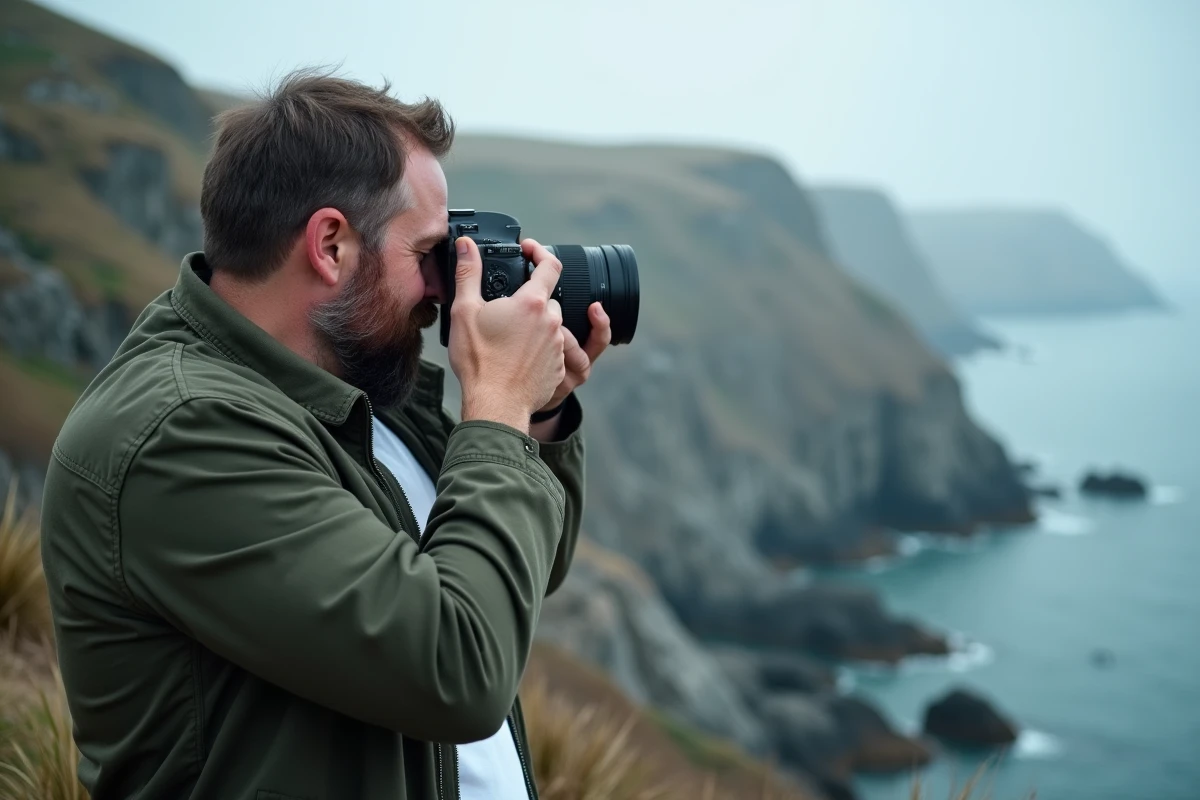
These three functions do not exclude each other. They can be combined depending on the scene. A street photographer might use AF-C for tracking, activate AEL on a shadow area to freeze the exposure, then switch briefly to MF for very precise composition in low light.
Customizing buttons plays a central role in this combination. On a Sony camera, the AF/MF lever allows for instant switching between the two focus modes, while the AEL button remains accessible to the thumb. Nikon and Canon offer similar configurations, sometimes under the name “back-button focus,” where focusing is separated from the shutter release and assigned to a rear button.
Mastering these three settings allows for separating sharpness and exposure, two parameters that automatic modes link by default. This separation provides finer control over the final output, regardless of the type of scene being photographed.