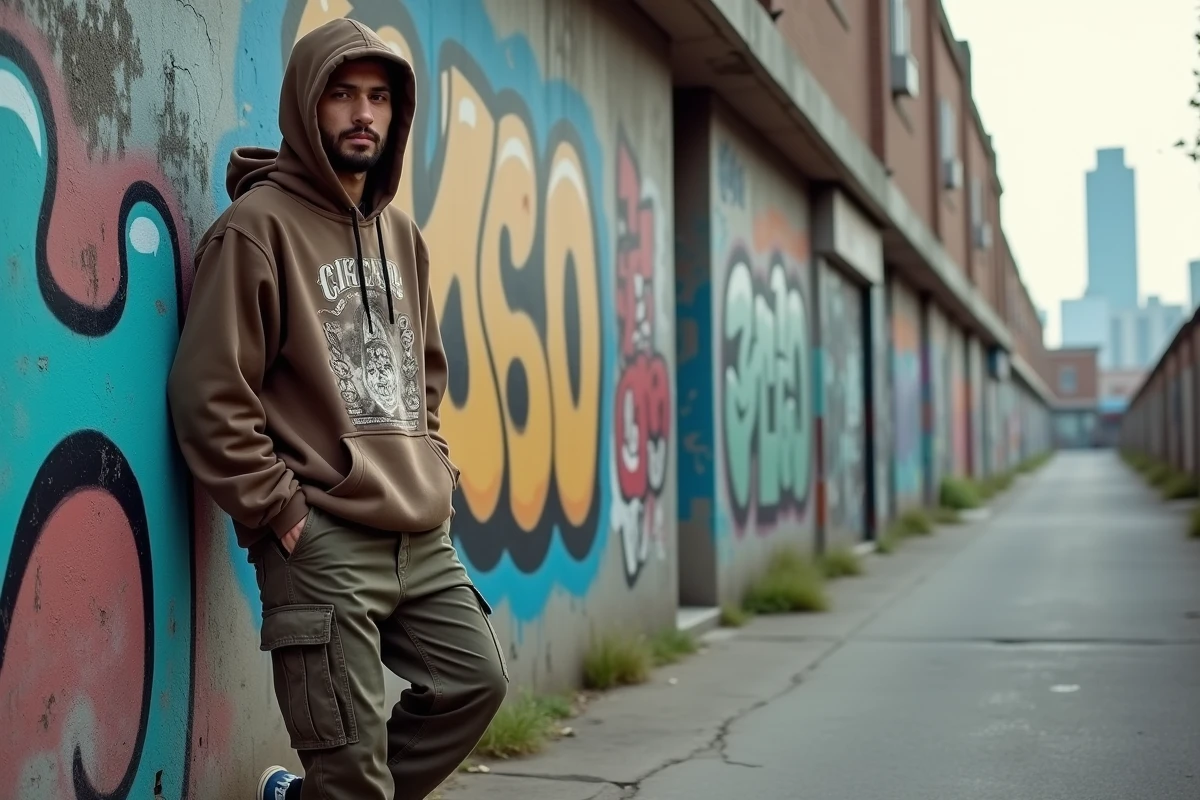
Streetwear today represents a distinct segment of the fashion industry, present in both independent boutiques and haute couture runways. Its evolution, often summarized as a linear journey from the street to luxury, masks more complex mechanisms: tensions between cultural authenticity and commercial logic, rapid saturation cycles, and, recently, regulatory constraints that are reshaping the rules of the game.
Quiet streetwear and logo fatigue: a recent stylistic shift
The streetwear that established itself between 2015 and 2020, with its oversized logos and orchestrated drops to create scarcity, shows signs of fatigue. Several industry analyses describe a shift towards a more streamlined and minimalist streetwear.
Hoodies, joggers, and sneakers remain in wardrobes, but in monochrome versions, with cuts borrowed from tailoring. This movement, sometimes referred to as “quiet streetwear,” aligns with the broader trend of “quiet luxury” that emerged after 2022.
To understand the evolution of streetwear with Klottra, one must assess what this shift implies: brands that built their identity on ostentation must rethink their visual vocabulary without losing their original community. The logo does not disappear, but it becomes discreet, sometimes reduced to a finishing detail or an inner label.

Luxury and streetwear collaborations: is the model reaching its limits?
The collaboration between Louis Vuitton and Supreme, often cited as a turning point, paved the way for a proliferation of partnerships between luxury houses and urban labels. The mechanism relies on an exchange of symbolic capital: the luxury brand gains relevance with a young audience, while the streetwear label gains access to distribution channels and institutional legitimacy.
This model has produced visible results. The appointment of designers from the streetwear culture to the heads of historic houses (Virgil Abloh at Louis Vuitton, followed by others with similar profiles) has blurred the line between haute couture and urban clothing.
However, the proliferation of collaborations poses a readability issue. When each season brings its share of “collabs,” the scarcity effect that made them appealing erodes. Market opinions do not converge: some players believe that collaboration remains a growth lever, while others see it as a format on the verge of becoming commonplace.
European environmental regulations and impact on drops
The regulatory constraints being prepared in Europe weigh directly on the economic model of streetwear. The European Strategy for Sustainable and Circular Textiles, as part of the Green Deal, notably includes a requirement for environmental labeling on textile products.
For streetwear brands, this perspective changes the game on several fronts:
- The model of high-turnover “drops,” which relies on limited series produced quickly, faces sourcing traceability requirements (cotton, recycled polyester) that extend timelines and increase costs.
- Mandatory environmental labeling could expose the gap between the “eco-responsible” marketing discourse of certain brands and the reality of their production chain.
- Capsules produced in small quantities are not automatically more virtuous than mass production if air transport and conventional raw materials remain the norm.
The available data does not yet allow for measuring the concrete impact of these regulations on the revenue of streetwear brands, as the texts are still being finalized. The direction is clear, but the details remain to be specified.
Recycled polyester and cotton: complex trade-offs
Recycled polyester, often highlighted as a solution, has its own limitations: it releases plastic microfibers during washing, and its closed-loop recycling remains marginal. Organic cotton, on the other hand, requires more arable land for a lower yield. No single material solves the environmental equation of urban textiles.

Training and institutional recognition of streetwear in France
Streetwear is also gaining ground in academic institutions. The Institut Français de la Mode (IFM) has developed programs integrating urban sportswear culture, notably through a partnership with Nike. The LVMH Prize, for its part, has regularly included in its finalist lists creators whose work is rooted in streetwear aesthetics.
This institutional recognition marks a change in status. Streetwear is no longer treated as a popular sub-category of fashion, but as a creative territory studied and valued on par with classic ready-to-wear. Fashion schools are now training designers who master both the cut of a blazer and that of an oversized hoodie.
This integration raises a question that the industry has not yet resolved: at what point does a streetwear garment, validated by luxury institutions and fashion schools, cease to be “from the street” and simply become fashion? The boundary between streetwear and high-end ready-to-wear has never been so blurred.
Streetwear continues to transform, pulled in sometimes contradictory directions: between stylistic discretion and ostentatious heritage, between a model of rapid drops and regulatory pressure towards sustainability. Its next mutation will depend as much on the creative choices of designers as on the legal frameworks being developed in Brussels.