
On a four-cylinder inline engine, cylinder number 1 can be located on the timing side or the flywheel side depending on the manufacturer. This lack of a universal convention leads to diagnostic errors, particularly during ignition timing or when replacing individual coils. Identifying the correct cylinder without disassembling anything relies on a method that cross-references several clues: visual markers on the block, manufacturer documentation, and firing order.
Engine code and manufacturer diagram: the reliable starting point
Before even opening the hood, the engine code engraved on the block or listed on the registration document (marker D.2 in France) directs you to the correct documentation. Each family of engines has its own numbering scheme, and two engines from the same manufacturer may follow different logics.
Searching for the engine code in the technical review or workshop manual of the vehicle provides access to the cylinder numbering plan. This document indicates cylinder number 1 in relation to a fixed reference on the block, usually the timing side or the flywheel/clutch side. To know precisely where cylinder number 1 is located on a given model, this documentary step remains the most reliable.
Online databases from manufacturers and technical reviews (Haynes, RTA) reproduce these diagrams. Ignoring this step and relying on a general rule like “always on the timing belt side” exposes one to error, as the rule varies from one block to another.
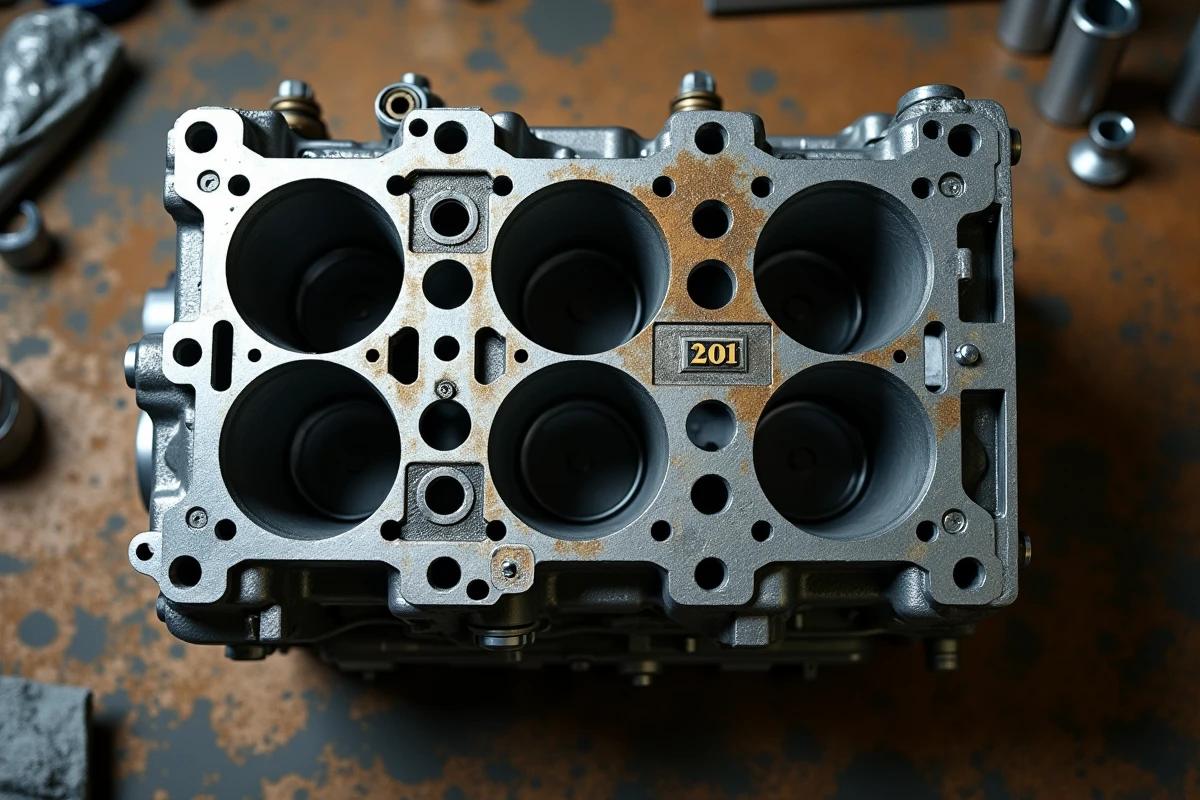
Visual clues on the engine block to locate cylinder 1 without disassembly
Several visible elements without tools can confirm or cross-check the information from the manufacturer’s diagram.
- The numbering cast or stamped directly on the block: some manufacturers engrave a “1” near the first cylinder, on the oil pan or cylinder head. A quick wipe and a lamp are enough for identification.
- The top dead center (TDC) marker on the crankshaft pulley: it is located on the side where cylinder 1 reaches its top stroke. On an inline engine, the timing side often carries the TDC marker, which frequently coincides with the position of cylinder 1, but not always.
- The wiring order of the spark plug wires or pencil coil connectors: on modern engines with individual ignition, each coil is wired according to the manufacturer’s plan. The connector marked “1” or the position closest to the timing marker corresponds to the first cylinder.
- The location of the crankshaft position sensor: on many blocks, this sensor is installed on the cylinder 1 side, as it needs to detect the first piston passing TDC to synchronize injection.
None of these clues taken individually guarantees correct identification. However, when two or three match the manufacturer’s diagram, the confirmation is solid.
V engines and special architectures: a numbering that can mislead
On an inline engine, the numbering follows a sequential order from one end of the block to the other. On a V engine, the logic changes radically. The two rows of cylinders each follow their own sequence, and cylinder 1 can be located on the front or rear row depending on the manufacturer.
With some manufacturers, the left row (from the driver’s perspective) carries the odd numbers and the right row the even numbers. Others assign numbers 1 to 3 (or 1 to 4) to one row, then 4 to 6 (or 5 to 8) to the other. Without the diagram for the exact model, visual identification alone leads to a dead end.
V-twins (like some motorcycle twins) add a nuance: the distinction between front cylinder and rear cylinder depends on the engine’s orientation in the frame. Harley-Davidson documentation, for example, explicitly distinguishes the rear cylinder in its diagnostic procedures, confirming that physical position cannot be guessed by sight.
The case of flat engines
Flat-four and flat-six engines (Subaru, Porsche) distribute their cylinders on either side of the crankshaft. Cylinder 1 is generally located on the driver’s side and the timing side, but again, only the manufacturer’s diagram is authoritative. A mechanic accustomed to inline engines who works on a boxer for the first time can easily make a mistake without documentation.

Firing order and numbering direction: two concepts not to be confused
The numbering of the cylinders refers to their physical position on the block. The firing order refers to the sequence in which the spark plugs receive the spark. The two pieces of information are related but distinct, and confusing them can lead to wiring errors.
On a common four-cylinder inline engine, the firing order is often 1-3-4-2 or 1-2-4-3. Cylinder 1 is the first to receive the spark in the cycle, allowing for an indirect verification: by placing the engine at TDC of cylinder 1 (marker on the crankshaft pulley aligned), both valves of cylinder 1 should be closed. If they are open, you are at TDC of the associated cylinder in the firing order, not at compression TDC of cylinder 1.
This verification using the valves works without electronic diagnostic tools. It allows for physical confirmation of which cylinder is indeed number 1 once the engine is set to the TDC marker.
Cross-referencing method for reliable identification of cylinder 1
Rather than relying on a single source, cross-referencing three pieces of information eliminates almost all errors:
- The numbering diagram from the technical review or manufacturer manual, accessible via the engine code.
- A visual clue on the block (molded number, position of crankshaft sensor, TDC marker).
- The verification of the valves at top dead center: closed valves on the cylinder assumed to be number 1, engine set to the TDC marker.
This approach works on the majority of combustion engines, whether inline, V, or flat. It requires neither disassembly nor specialized tools, just access to the engine compartment and the vehicle documentation.
The most common mistake remains assuming that cylinder 1 is always on the timing belt side. This is true for many European and Japanese inline engines, but the exceptions are numerous enough that this rule cannot serve as certainty. The documentary reflex, even if quick, avoids a rewiring of coils or an ignition timing offset by one turn.