
The Mona Lisa is an oil painting on poplar panel painted by Leonardo da Vinci in the early 16th century. The painting measures 77 cm by 53 cm and is currently housed in the Louvre Museum, in the Salle des États, protected by an insulated case and a bulletproof glass. Behind this protection and fame lie specific technical and historical questions, some of which have only recently been answered.
Lead White and Ground Layer: What Chemistry Found Beneath the Paint
In 2023, a team of researchers used a particle accelerator (synchrotron radiation) to analyze a micro-sample from the paint layer of the Mona Lisa. The result was surprising: the ground layer contains lead white, a rare compound of lead white pigment.
This compound forms when lead white is mixed with oil and heated. The presence of lead white indicates that Leonardo da Vinci likely prepared his panel with a thick paste of lead white dissolved in hot oil, a process that facilitates application and creates a luminous underlayer that enhances transparency effects.
This type of preparation had never been documented in Leonardo da Vinci before. However, it has been found in works by Rembrandt, painted more than a century later. To delve deeper into the history of the Mona Lisa on Voiloo, this detail from chemistry sheds light on the painter’s experimental method well beyond just sfumato.

Lisa Gherardini: Historical Consensus and Gray Areas on the Model
The identification of the model is based on a testimony from Giorgio Vasari, biographer of Renaissance artists, who named Lisa Gherardini, wife of Francesco del Giocondo, a Florentine silk merchant. The name “Joconde” actually derives from “Giocondo”.
This identification is now the most widely accepted among art historians. However, the term “consensus” does not mean absolute proof. Vasari never saw Leonardo paint the portrait and relied on indirect sources.
What the Documents Do Not Confirm
Some biographical details often associated with the portrait are not supported by compelling documents. The idea that Lisa Gherardini was pregnant at the time of the sitting, for example, is based on a clothing interpretation (the transparent veil on her shoulders, sometimes associated with motherhood in Florence). No period records confirm this hypothesis.
- The veil worn by the model is a guarnello, a common garment among Florentine women of the time, not necessarily linked to pregnancy.
- No commission contract between Francesco del Giocondo and Leonardo da Vinci has been found to date.
- The painting was never delivered to the supposed patron, which fuels the hypothesis that Leonardo kept it for himself, perhaps as a support for artistic experimentation.
Mona Lisa’s Sfumato: A Technique Without Visible Outlines
Sfumato refers to a technique of layering extremely thin and translucent layers of paint, applied successively to create imperceptible transitions between shadow and light areas. The word comes from the Italian “sfumare,” which means “to evaporate.”
On the Mona Lisa, this technique is visible around the eyes and mouth. The corners of the lips are not drawn by a line but suggested by a gradual variation in tone. The smile changes appearance depending on the angle of view and distance, not by arbitrary optical illusion, but because the contours do not exist as lines.
A Laser Scanner to Measure the Layers
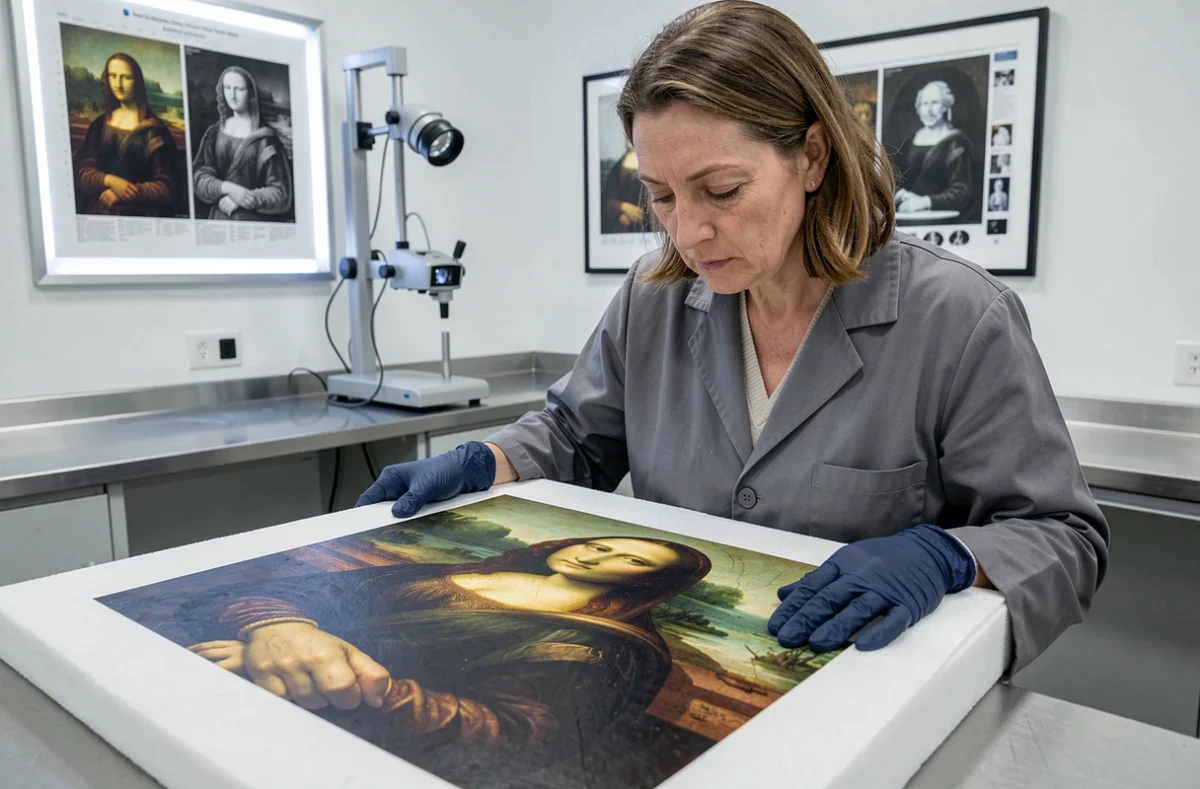
In 2004, a multispectral laser scanner examination was conducted on the painting at the request of the Louvre. This survey allowed for measuring the thickness of the glaze layers and documenting the overlays. The obtained images do not reveal “hidden truths” in a spectacular sense: they confirm a patient working method, where each layer slightly modifies the perception of the previous one.
This type of analysis also shows that the Mona Lisa has never been restored. The visible cracks on the surface are the result of the natural aging of the poplar panel and varnish, not due to degradation from interventions.
The Louvre and the Future of the Painting’s Presentation
The Louvre Museum has announced a large-scale renovation plan that aims to modify the visiting conditions of the Mona Lisa. The project includes the possibility of a dedicated space, separate from the rest of the Salle des États.
This decision is not solely about crowd management. Internal reports at the museum mention deteriorating facilities and aging air conditioning equipment that struggle to maintain stable temperature and humidity conditions. For a wood panel artwork, thermal variations pose a direct threat: the wood expands and contracts, accelerating cracking.
The budget mentioned for this comprehensive renovation plan for the Louvre is in the hundreds of millions of euros. The relocation of the Mona Lisa to a new space is therefore as much a conservation issue as it is a response to recurring visitor complaints, often disappointed by the imposed distance and the difficulty of observing the painting under good conditions.
The Mona Lisa remains an active object of study. Each new analysis technology (synchrotron, laser scanner, multispectral imaging) adds a layer of information about Leonardo da Vinci’s method, without resolving all questions. The absence of a contract, the absence of restoration, and the absence of contours form three particularities that, taken together, explain why this modestly sized painting continues to engage chemists, historians, and conservators.